


© Copyright Vladimir Birgus
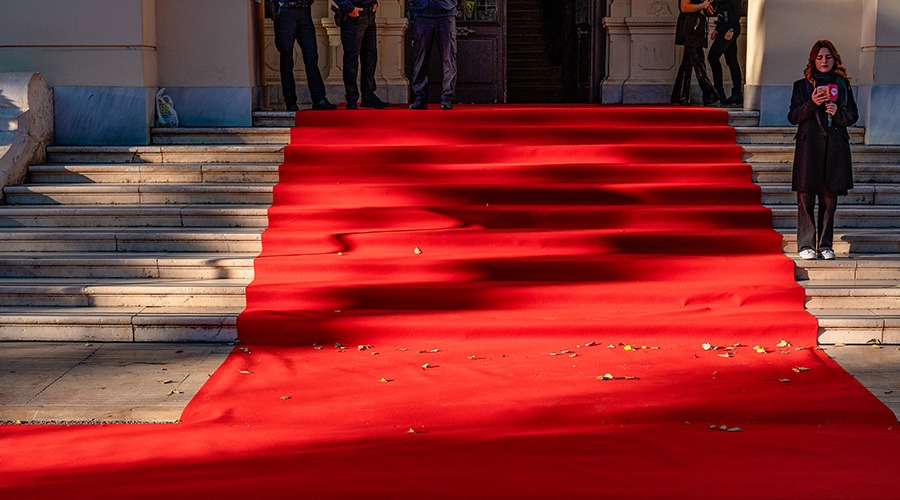
Color was taboo in documentary photography. Vladimír Birgus broke it already in the 1980s
The use of color in documentary photography was neither common nor recommended in 1980s Czechoslovakia. At Prague’s FAMU, some instructors even warned students against it. It was precisely at that time that Vladimír Birgus began working with color documentary photography in a highly inventive way. In the podcast Behind the Shutter, he talks not only about this, but also about his work as a photography historian and educator.
Vladimír Birgus, a native of the Frýdek-Místek region, has significantly shaped contemporary Czech photography, and in several roles: of course as a photographer, but also as a historian, educator, and author of many books. He celebrated his seventieth birthday on May 5 with two major exhibitions. The first, titled Black and White, presented his work from the 1970s to the 1990s. The second, titled Red and Blue, is on view at Leica Gallery Prague until June 9.
“It is a contrast to the first exhibition. It includes only color photographs, and moreover focuses solely on red and blue. This is because Leica Gallery is not very large, and curator Martin Dostál and I decided it would be better to concentrate on two strong colors rather than exhibit too many photographs,” explains the photographer, who is considered one of the pioneers of Czech color documentary photography.
Color fascinated him already in the 1980s
Color photography was, of course, already relatively widespread at the time, but it was mainly the domain of fine art photography or, for example, the nude, Birgus explains. “At that time I was already teaching at FAMU, and within documentary photography Pavel Štecha explicitly warned against color photography,” he adds.
In the United States, however, excellent color documentary work already existed, and it was also on the rise in nearby Germany. “Here, for example, Jan Ságl was working in color,” Birgus notes. According to him, he was one of the photographers who used color in documentary photography in a truly interesting way.
What does a great photographer need? Talent and passion.
As both a photography historian and a teacher, Vladimír Birgus has encountered many phenomenal photographers. According to him, they all share two things: talent and enormous dedication. “Truly good documentary photographers devote the maximum to it,” he says. However, there are two types.
An example of the first is Josef Koudelka, who devotes everything to photography and sacrifices his personal life for it. “And then there is the type represented, for example, by Jindřich Štreit, who is not only a great photographer but also helps people on the margins of society draw attention to their problems and is above all an excellent teacher who works with students from morning to evening and inspires young people to engage with documentary photography.”
First competition at eleven, first solo exhibition at seventeen
Vladimír Birgus entered his first photography competition as a schoolboy, when he was eleven years old. What did he photograph at the time? “They were certainly staged photographs,” he recalls. One of his major inspirations then was, for example, Taras Kučynskyj.
His first solo exhibition came at the age of seventeen. “These were still staged images. There were various sequences; I also photographed, for example, details of a nude of a Black man and a white woman. But even at that time I was intensively engaged in documentary photography, and my second exhibition (at the V Podloubí Gallery in Olomouc) focused on it,” Birgus adds.
Literature, theatre, film—and photography as well
Although Vladimír Birgus is one of the best-known Czech educators focused on photography, he originally began studying something else. “It was Literature, Theatre and Film at the Faculty of Arts in Olomouc,” he says. According to him, the atmosphere at the school was much more relaxed than, for example, at the Faculty of Arts in Prague. “Teachers were not afraid to talk about banned authors; they showed us banned films,” he recalls.
However, because he was also drawn to photography, he first attended the so-called school of Ján Šmok. Eventually, he applied to FAMU and was accepted. “I didn’t want to give up my studies in Olomouc, so I studied at both schools at the same time,” he says, considering it an advantage. “I’m glad that when I write today about something in the history of photography, I also have an overview of what was happening in literature and film,” he explains.
He began teaching photographers immediately after finishing his studies
“Right after I graduated from FAMU in 1978, Professor Šmok offered me a teaching position. To this day I am grateful that I can spend most of my life teaching,” says Birgus, who today heads the Institute of Creative Photography at the Faculty of Philosophy and Science of Silesian University in Opava.
The institute has earned an excellent reputation, attracts international students and teachers, and its graduates succeed both in practice and in various photography competitions. “I think the composition of the teaching staff is the main thing that attracts students to our school,” Birgus explains.
“We don’t have a studio system where students study under one teacher for five or six years. They can choose any of the twenty-one instructors for their final projects or thesis supervision,” he adds. The school also includes several Polish lecturers (Jan Brykczyński, Arkadiusz Gola, Michał Szalast).
Dozens of books and numerous international exhibitions
Vladimír Birgus is the author or co-author of a long list of publications. Asked how many books he has written, he shrugs. “I don’t know exactly off the top of my head, but certainly more than seventy,” he states. He often collaborated on them with Jan Mlčoch or Pavel Scheufler. Most were also published in English, and many have played an important role in promoting Czech photography abroad.
Of the many major exhibitions of famous Czech photographers that Vladimír Birgus has prepared around the world, the one he probably enjoyed most was dedicated to the work of Josef Sudek. It was shown at the National Gallery of Canada and in Paris. “We had the opportunity to work on it for three years and visit Sudek’s collections in various countries,” he recalls.
He himself had the chance to meet Sudek. “But it was more of a chance encounter in the street, and once we sat together at the same table in a pub,” he says.
In the podcast Behind the Shutter, the discussion also turns to the exhibition Nude in Czech Photography 1960–2000, which he curated and which had extremely high attendance. “If I’m not mistaken, about 47,000 people came to see it in Prague at the Castle, but that was nothing compared to when it was included in the photography festival in Moscow. It took place at the Manege alongside an exhibition by Annie Leibovitz,” Birgus recalls. Some 360,000 people attended over two months, and there were long queues. “But I have no illusions—it was mainly because of Annie Leibovitz,” he adds.
Tomáš Vocelka
https://magazin.aktualne.cz/foto/podcast-za-zaverkou-vladimir-birgus/r~649e156c12af11efb589ac1f6b220ee8/